
GEORGIAN
BIOMEDICAL
& MEDICAL NEXUS
Former Georgian Biomedical News
ISSN (Online): 2720-8796
ORIGINAL RESERCH
Beyond Dialysis: Is Georgia Ready for Comprehensive Conservative Care for Elderly Patients with
End-Stage Renal Disease?
ABSTRACT
Background: Comprehensive conservative care (CCC) is increasingly recognized as a valid treatment option for frail elderly patients with end-stage renal disease (ESRD). However, despite international guideline recommendations, CCC implementation remains limited, particularly in healthcare systems where dialysis-centered care predominates. Cultural attitudes toward end-of-life care, inadequate supportive care infrastructure, and healthcare financing models may substantially influence treatment choices and patient trajectories.
Objectives: This study evaluated the feasibility and real-world implementation of comprehensive conservative care in elderly patients with ESRD in Georgia and identified clinical, cultural, and healthcare system-related barriers to its use.
Methods: This prospective, observational, comparative study included 64 patients aged ≥65 years with ESRD, frailty, and a high comorbidity burden who were treated between 2021 and 2023. We classified patients into Stable CCC, Stable Dialysis, or Transition Treatment groups based on their treatment trajectory during follow-up. We compared hospitalization, mortality, treatment trajectories, causes of death, and place of death across groups.
Results: During the 12-month follow-up, 30 of 64 patients (46.9%) died, with no significant difference in mortality between treatment groups. Hospitalization differed significantly across groups (p = 0.005), occurring in 21.1% of patients receiving Stable CCC, 62.9% of those receiving Stable Dialysis, and 70.0% of those in the Transition Treatment group. The Transition Treatment group had the highest hospitalization burden and the lowest probability of remaining hospitalization-free during follow-up. Place of death also differed significantly between groups (p = 0.016), with home deaths more frequent among patients receiving Stable CCC.
Conclusions: Implementation of comprehensive conservative care in Georgia remains constrained by cultural, structural, and healthcare system barriers. Patients in the Transition Treatment group had a higher hospitalization burden and predominantly hospital-based deaths, although these associations should be interpreted cautiously given the observational design and small sample size. Expanding nephropalliative care services, integrating advance care planning, improving physician education, and implementing healthcare policy reforms that support CCC may improve person-centered care for frail elderly patients with ESRD.
Keywords: Advance care planning; chronic kidney disease; comprehensive conservative care; dialysis; elderly patients; end-stage renal disease; frailty; hospitalization; nephropalliative care; palliative care.
BACKGROUND
Chronic kidney disease (CKD) represents a substantial global, regional, and national health burden. 1 Although kidney replacement therapy is life-saving for many patients, evidence suggests that dialysis may not provide the same benefit for all patients with end-stage renal disease (ESRD). In frail elderly patients with multiple comorbidities, dialysis may be associated with deterioration in functional status and quality of life. In contrast, comprehensive conservative care (CCC) offers an alternative approach focused on preserving function, managing symptoms, and supporting a dignified end-of-life experience.2,3 CCC is a planned, holistic, person-centered approach that includes prognostic assessment, advance care planning, shared decision-making, active symptom management, and psychological, social, family, cultural, and spiritual support. 2,4
There has been an important shift from a paternalistic model toward patient- and person-centered care, in which patients and their families or caregivers are actively involved in shared decision-making and care plans are guided by individual goals, values, and preferences. 5,6 International guidelines, including those from Kidney Disease: Improving Global Outcomes (KDIGO) and the European Renal Best Practice (ERBP) group, recommend CCC as a valid option for frail elderly patients with advanced CKD. 7,8 The 2024 KDIGO Clinical Practice Guideline for the Evaluation and Management of Chronic Kidney Disease recommends informing people with CKD about options for kidney replacement therapy (KRT) and CCC, supporting CCC as an option for those who choose not to pursue KRT, and providing access to resources that enable advance care planning (ACP) for people with recognized end-of-life care needs, including those receiving comprehensive conservative care. 7
Despite these recommendations, CCC implementation in clinical practice remains inconsistent. Barriers include limited physician training in supportive care, inadequate patient understanding of treatment options, and variability in perceptions of conservative management. 9,10 Importantly, some patients and families perceive CCC as "no treatment" rather than as an active supportive care pathway. 11
These challenges may be particularly relevant in Georgia. A predominantly paternalistic model of care persists in many settings, and patients may be directed toward dialysis without systematic consideration of frailty, prognosis, or individual goals of care. 5,12 Cultural factors may further complicate decision-making, as discussions about death and end-of-life care are often avoided, potentially limiting engagement in advance care planning. 4,13
In addition, structural barriers within the healthcare system substantially affect treatment choices. In Georgia, the state fully covers dialysis and hospitalization, whereas CCC and its associated medications are not reimbursed. This financial imbalance may strongly influence both clinical recommendations and patient decisions and may contribute to greater use of dialysis even when it does not align with patient-centered goals. 14
Similar gaps in the availability and organization of conservative kidney management have been reported across Eastern and Central Europe. 15 Given these clinical, cultural, and system-level challenges, there is a need to better understand how CCC is implemented in routine practice in Georgia, particularly among frail elderly patients with ESRD.
This study aimed to evaluate the feasibility and real-world implementation of comprehensive conservative care (CCC) in elderly patients with end-stage renal disease (ESRD) in Georgia, with particular emphasis on clinical, cultural, and healthcare system-related barriers.
Additionally, we compared hospitalization, mortality, treatment trajectories, causes of death, and place of death among patients receiving Stable CCC, Stable Dialysis, and Transition Treatment to characterize outcomes across these treatment pathways and inform clinical decision-making.
METHODS
This prospective, observational, comparative, single-center study was conducted between 2021 and 2023 in the Nephrology Department of Tbilisi State Medical University (TSMU) and the Ingorokva High Medical Technologies University Clinic.
We included 64 patients. Eligible participants were aged ≥65 years, had end-stage renal disease (ESRD), had a Clinical Frailty Scale (CFS) score ≥5, and had a comorbidity burden defined by a Charlson Comorbidity Index (CCI) ≥3. We excluded patients who transferred to other dialysis centers or declined to participate.
After assessing each patient's prognosis using established mortality risk predictors, including the REIN score, Bansal score, and CFS, we selected the treatment modality through shared decision-making.
We followed each patient for 12 months (365 days).
The primary outcomes were hospitalization and mortality at 3, 6, and 12 months. Patients were classified into three groups according to their treatment trajectory during follow-up: (i) Stable Comprehensive Conservative Care (CCC), comprising patients who remained on CCC throughout the study period; (ii) Stable Dialysis, comprising patients who remained on either hemodialysis or peritoneal dialysis throughout the study period; and (iii) Transition Treatment, comprising patients who transitioned from CCC to dialysis or from dialysis to CCC during follow-up.
Patients who opted for CCC received active symptom-focused management, including treatment of anemia, fluid overload, metabolic acidosis, nausea, and pruritus. Nephrologists, social workers, and palliative care specialists provided care. A nephrologist reviewed patients monthly, while home-based care relied primarily on family support. Formal psychological support was not available. Advance care planning (ACP) was documented, and discussions regarding dialysis withholding and do-not-resuscitate (DNR) decisions were incorporated into the care-planning process.
Ethical approval and informed consent
The Tbilisi State Medical University Biomedical Research Ethics Committee granted ethical approval (approval No. 6-2020/83). We obtained written informed consent from each patient or caregiver. We anonymized patient data and kept it confidential.
Statistical analysis
For descriptive analyses, we reported quantitative variables as mean ± standard deviation (SD) and median with interquartile range (IQR), and categorical variables as frequencies and percentages.
We evaluated time to death and time to first hospitalization using Kaplan–Meier analysis. We used Cox proportional hazards regression to compare hazards across treatment groups, with the Stable CCC group as the reference. We also estimated hospitalization-free probabilities at 90, 180, and 365 days after treatment initiation.
We calculated mortality and first-hospitalization incidence rates for each treatment group using patient-days at risk. We followed patients for up to 365 days after treatment initiation.
We used Fisher's exact test to compare hospitalization status, causes of death, and place of death across treatment groups because of small cell counts.
RESULTS
The cohort comprised 64 patients treated at the Nephrology Department of Tbilisi State Medical University (TSMU) and the Ingorokva High Medical Technologies University Clinic between March 2021 and March 2023. TABLE 1 represents patient characteristics..
TABLE 1. Description of the cohort


Mortality
Of the 64 patients included in the study, 30 (46.9%) died during the 12-month follow-up. Mortality was 36.8% (7/19) in the Stable CCC group, 54.3% (19/35) in the Stable Dialysis group, and 40.0% (4/10) in the Transition Treatment group. The corresponding mortality incidence rates were 2.8, 3.5, and 2.3 deaths per 1,000 patient-days, respectively (TAB.2).
TABLE 2. Mortality and first-hospitalization incidence rates by treatment group per 1,000 patient-days

Kaplan–Meier analysis showed different survival patterns across the three treatment groups. The Stable CCC group had the highest estimated survival throughout follow-up, whereas the Stable Dialysis group had the lowest estimated survival at later time points; the Transition Treatment group showed an intermediate pattern. Median survival was approximately 200 days in the Stable Dialysis group and 300 days in the Transition Treatment group. Median survival was not reached in the Stable CCC group because the estimated survival probability remained above 50% throughout follow-up (FIG.1).
FIGURE 1. Kaplan–Meier survival estimates for mortality by treatment group

Compared with the Stable CCC group, the Stable Dialysis group had no significantly higher hazard of death (HR 1.34, 95% CI 0.56–3.20; p=0.507), and the Transition Treatment group had no significantly lower hazard of death (HR 0.92, 95% CI 0.27–3.16; p=0.899).
Causes and place of death
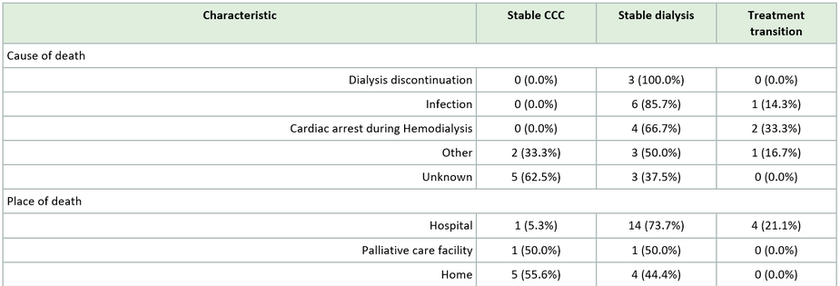
Among deaths attributed to infection, 6 of 7 (85.7%) occurred in the Stable Dialysis group; among deaths attributed to cardiac arrest during hemodialysis, 4 of 6 (66.7%) occurred in the Stable Dialysis group. All deaths attributed to dialysis discontinuation occurred in the Stable Dialysis group (3/3, 100%). Of the eight deaths classified as having an unknown cause, five (62.5%) occurred in the Stable CCC group. The distribution of causes of death differed across treatment groups with borderline statistical significance (Fisher's exact test, p=0.054) (TAB.3).
Most deaths in the Stable Dialysis group occurred in a hospital or clinical setting (14/19, 73.7%), whereas deaths in the Stable CCC group occurred more frequently at home (5/7, 71.4%). All deaths in the Transition Treatment group occurred in a hospital or clinical setting (4/4, 100%), including deaths during hemodialysis. The distribution of place of death differed significantly across treatment groups (Fisher's exact test, p=0.016) (TAB.3).
TABLE 3. Distribution of causes and place of death by treatment group
Hospitalization
Of the 64 patients included in the study, 31 (48.4%) were not hospitalized during the 12-month follow-up, whereas 33 (51.6%) experienced at least one hospitalization. Among the 33 hospitalized patients, 24 (72.7%) were hospitalized once, four (12.1%) twice, four (12.1%) three times, and one (3.0%) four times.
The proportion of patients experiencing at least one hospitalization differed significantly across treatment groups. Hospitalization occurred in 21.1% (4/19) of patients in the Stable CCC group, compared with 62.9% (22/35) in the Stable Dialysis group and 70.0% (7/10) in the Transition Treatment group (Fisher's exact test, p=0.005). The incidence rates of first hospitalization were 1.9, 6.6, and 8.3 events per 1,000 patient-days in the Stable CCC, Stable Dialysis, and Transition Treatment groups, respectively (TAB.2).
At 90 days, the estimated probabilities of remaining hospitalization-free were approximately 75% in the Stable CCC group, 47% in the Stable Dialysis group, and 30% in the Transition Treatment group. At 180 days, the corresponding probabilities were approximately 56%, 35%, and 15%, respectively. By 365 days, the estimated hospitalization-free probabilities were approximately 56%, 23%, and 15%, respectively. Overall, the Stable CCC group maintained the highest estimated probability of remaining free from a first hospitalization during follow-up, whereas the Transition Treatment group had the lowest probability (FIG.2).
TABLE 3. Kaplan–Meier estimates of time to first hospitalization by treatment group

In Cox proportional hazards regression, compared with the Stable CCC group, patients in the Stable Dialysis group had a significantly higher hazard of first hospitalization (HR 3.50, 95% CI 1.21–10.17; p=0.021), as did patients in the Transition Treatment group (HR 3.93, 95% CI 1.16–13.45; p=0.029).
DISCUSSION
To our knowledge, this study provides the first description of the real-world implementation of comprehensive conservative care (CCC) in elderly patients with end-stage renal disease (ESRD) in Georgia.
Our findings suggest that, despite increasing international recognition of CCC as a valid treatment pathway for frail elderly patients with advanced chronic kidney disease (CKD), 7,8 substantial challenges may limit its integration into nephrology practice in Georgia. These barriers appear to be multifactorial and include cultural attitudes toward end-of-life care, organizational constraints within the healthcare system, and limited integration of supportive and palliative nephrology services. 2,16
Recent evidence continues to highlight uncertainty regarding the comparative outcomes of dialysis and conservative kidney management in older adults, particularly among patients with substantial frailty and multimorbidity. 17,18
A key finding was the high hospitalization burden in the Transition Treatment group. Patients in this group had a significantly higher hazard of first hospitalization than those receiving Stable CCC and the highest proportion experiencing at least one hospitalization. Notably, all transitions from CCC to dialysis were prompted by fluid overload, indicating that dialysis was initiated in the setting of clinical deterioration. Therefore, the higher hospitalization burden observed in this group may reflect the clinical instability that necessitated dialysis initiation rather than an adverse effect of the transition itself. 19
The Transition Treatment group also had exclusively hospital- or clinical-setting deaths, whereas most deaths in the Stable CCC group occurred at home. Overall, palliative care use was limited and absent in the Transition Treatment group. These findings are consistent with a predominantly hospital-centered end-of-life trajectory among patients who transitioned between treatment pathways; however, they may also reflect limited access to home-based palliative care and differences in illness severity rather than an effect of treatment modality itself. 2,16
The distribution of causes of death also differed across groups, although the overall comparison was borderline statistically significant. Deaths classified as infection or cardiac arrest during hemodialysis occurred predominantly in the Stable Dialysis group, whereas deaths of unknown cause were more frequent in the Stable CCC group. The latter may partly reflect less intensive diagnostic ascertainment outside hospital settings. Given the observational design and the small number of events within individual categories, interpret these findings cautiously and do not consider them evidence of a causal effect of treatment modality on cause of death. 20
Several factors may shape treatment trajectories in this population. In routine nephrology practice, elements of a predominantly paternalistic model of care may persist. Although international guidelines increasingly emphasize patient-centered decision-making, discussions regarding prognosis, supportive care, and end-of-life preferences may remain limited in some clinical settings 6,12 Consequently, dialysis may be presented as the default treatment option even for frail elderly patients with limited expected benefit. 13,21
Cultural factors may further complicate implementation of comprehensive conservative care (CCC) and advance care planning (ACP). Discussions about death and end-of-life care may be perceived as culturally sensitive, potentially limiting open communication among healthcare professionals, patients, and families. 4,13 Consequently, CCC may be misunderstood as withdrawal of care or "no treatment" rather than as an active, supportive, symptom-focused management strategy. 11 This perception may contribute to reluctance toward conservative management and delayed engagement in ACP. 19
Structural characteristics of the healthcare system may also influence treatment decisions. In Georgia, the state healthcare system fully covers dialysis and hospitalization. In contrast, components of CCC, including symptom-directed medications, psychological support, and palliative care services, are not routinely reimbursed. This financial asymmetry may inadvertently favor dialysis-centered pathways and reduce the feasibility of implementing structured CCC programs. 14
Another important challenge is the limited availability of nephrology-specific supportive care services. Some nephrologists may have limited training or confidence in comprehensive conservative care and advance care planning. 16 Furthermore, specialized nephropalliative care programs remain underdeveloped in Georgia. These gaps may contribute to inconsistent implementation of conservative management and limited integration of supportive care principles into ESRD treatment planning. 2,8
These findings have several potential clinical and policy implications. First, they support earlier and more structured shared decision-making for frail elderly patients with ESRD. 6,13 Second, they underscore the importance of integrating ACP into routine nephrology practice before acute deterioration occurs.4 Third, they suggest that developing nephropalliative care services and reimbursement mechanisms for CCC-related treatments could improve access to person-centered conservative management pathways. 2,21
This study has several limitations. The relatively small sample size and observational design limited our ability to account for all potential differences between treatment groups. Treatment decisions were made through shared decision-making based on patients' clinical condition, prognosis, and preferences rather than through randomization; therefore, unmeasured differences between groups may have influenced the observed outcomes. In addition, ascertainment of cause of death may have been less precise for patients who died at home than for those who died in hospital. Despite these limitations, the prospective 12-month follow-up provides valuable real-world insight into CCC implementation in Georgia. It highlights clinically relevant differences in hospitalization and end-of-life care across treatment pathways. These findings may help inform the development of more structured conservative kidney care and provide a basis for larger prospective studies
CONCLUSIONS
Implementation of comprehensive conservative care in Georgia remains constrained by cultural, structural, and healthcare system barriers. Patients in the Transition Treatment group had a higher hospitalization burden and exclusively hospital- or clinical-setting deaths, whereas home death was more common among patients receiving Stable CCC. Because treatment allocation was nonrandom and the sample size was small, these associations should not be interpreted as causal. Expanding nephropalliative care services, integrating advance care planning, physician education, and healthcare policy reforms supporting CCC may improve access to person-centered care for frail elderly patients with ESRD.
AUTHOR AFFILIATION
1 Internal Medicine Department, Tbilisi State Medical University (TSMU), Tbilisi, Georgia
2 Nephrology Department, Tbilisi State Medical University and Ingorokva High Medical Technologies University Clinic (HTMC), Tbilisi, Georgia
ACKNOWLEDGEMENTS
This work was supported by a grant from Tbilisi State Medical University and the Shota Rustaveli National Science Foundation of Georgia (Grant No. PHDF-22-4619).
The authors used artificial intelligence tools (ChatGPT and Claude AI) solely for grammar correction and language editing; they reviewed all content.
REFERENCES
-
GBD Chronic Kidney Disease Collaboration. Global, regional, and national burden of chronic kidney disease, 1990-2017: a systematic analysis for the Global Burden of Disease Study 2017. Lancet. 2020;395(10225):709-733. doi:10.1016/S0140-6736(20)30045-3.
-
Davison SN, Levin A, Moss AH, Jha V, Brown EA, Brennan F, Murtagh FEM, Naicker S, Germain MJ, O'Donoghue DJ, Morton RL, Obrador GT. Executive summary of the KDIGO Controversies Conference on Supportive Care in Chronic Kidney Disease: developing a roadmap to improving quality care. Kidney Int. 2015;88(3):447-459. doi:10.1038/ki.2015.110.
-
Aiyegbusi OL. Comprehensive conservative care for kidney failure-the need for evidence-based guidance. Kidney Int Rep. 2024;9(8):2574. doi:10.1016/j.ekir.2024.06.013.
-
Tiansaard J, Bloomer MJ, Purtell L, Bonner A. Advance care planning interventions for adults with chronic kidney disease: a systematic review. J Ren Care. 2026;52(1):e70046. doi:10.1111/jorc.70046.
-
O'Hare AM, Rodriguez RA, Bowling CB. Caring for patients with kidney disease: shifting the paradigm from evidence-based medicine to patient-centered care. Nephrol Dial Transplant. 2016;31(3):368-375. doi:10.1093/ndt/gfv003.
-
Kanbay M, Basile C, Battaglia Y, Mantovani A, Yavuz F, Pizzarelli F, Luyckx VA, Covic A, Liakopoulos V, Mitra S. Shared decision making in elderly patients with kidney failure. Nephrol Dial Transplant. 2024;39(5):742-751. doi:10.1093/ndt/gfad211.
-
Kidney Disease: Improving Global Outcomes (KDIGO) CKD Work Group. KDIGO 2024 Clinical Practice Guideline for the Evaluation and Management of Chronic Kidney Disease. Kidney Int. 2024;105(4S):S117-S314. doi:10.1016/j.kint.2023.10.018.
-
Farrington K, Covic A, Nistor I, Aucella F, Clyne N, De Vos L, Findlay A, Fouque D, Grodzicki T, Iyasere O, Jager KJ, Joosten H, Macias JF, Mooney A, Nagler E, Nitsch D, Taal M, Tattersall J, Stryckers M, van Asselt D, Van den Noortgate N, van der Veer S, van Biesen W. Clinical Practice Guideline on management of older patients with chronic kidney disease stage 3b or higher (eGFR <45 mL/min/1.73 m2): a summary document from the European Renal Best Practice Group. Nephrol Dial Transplant. 2017;32(1):9-16. doi:10.1093/ndt/gfw411.
-
Sakthivel P, Mostafa A, Aiyegbusi OL. Factors that influence the selection of conservative management for end-stage renal disease: a systematic review. Clin Kidney J. 2024;17(1):sfad269. doi:10.1093/ckj/sfad269.
-
Oestreich T, Sayre G, O'Hare AM, Curtis JR, Wong SPY. Perspectives on conservative care in advanced kidney disease: a qualitative study of US patients and family members. Am J Kidney Dis. 2021 MAr;77(3):355-364.e1. doi:10.1053/j.ajkd.2020.07.0269. PMID: 33010345; PMCID: PMC8148987.
-
Murtagh FEM, Cohen LM, Germain MJ. The "no dialysis" option. Adv Chronic Kidney Dis. 2011;18(6):443-449. doi:10.1053/j.ackd.2011.10.007.
-
Schell JO, Cohen RA. A communication framework for dialysis decision-making for frail elderly patients. Clin J Am Soc Nephrol. 2014;9(11):2014-2021. doi:10.2215/CJN.02190314.
-
Merchant AA, Ling E. An approach to treating older adults with chronic kidney disease. CMAJ. 2023;195(17):E612-E618. doi:10.1503/cmaj.221427.
-
Jha V, Martin DE, Bargman JM, Davies SJ, Feehally J, Finkelstein F, Harris D, Misra M, Remuzzi G, Levin A. Ethical issues in dialysis therapy. Lancet. 2017;389(10081):1851-1856. doi:10.1016/S0140-6736(16)32408-4.
-
Alparslan C, Malyszko J, Caskey FJ, Aleckovic-Halilovic M, Hrušková Z, Arruebo S, Bello AK, Damster S, Donner JA, Jha V, Johnson DW, Levin A, Malik C, Nangaku M, Okpechi IG, Tonelli M, Ye F, Tesar V, Racki S. Capacity for the management of kidney failure in the International Society of Nephrology Eastern and Central Europe region: report from the 2023 ISN Global Kidney Health Atlas (ISN-GKHA). Kidney Int Suppl (2011). 2024;13(1):29-42. doi:10.1016/j.kisu.2024.01.006.
-
van Biesen W, van de Luijtgaarden MWM, Brown EA, Michel JP, van Munster BC, Jager KJ, van der Veer SN. Nephrologists' perceptions regarding dialysis withdrawal and palliative care in Europe: lessons from a European Renal Best Practice survey. Nephrol Dial Transplant. 2015;30(12):1951-1958. doi:10.1093/ndt/gfv284.
-
Yang JW, Natale P, Kim S, Kim M, Jeon MS, Yi D, Hong YA, Chung S, Park WY, Hyun YY, Kwon SH, Shin SJ, Park DA, Kim J, Jung JH, Strippoli GFM, Lee JY. Conservative kidney management versus dialysis for stage 5 chronic kidney disease in older people. Cochrane Database Syst Rev. 2025;12(12):CD015151. doi:10.1002/14651858.CD015151.pub2.
-
Scripcariu D, Covic A, Agavriloaei LM, Agavriloaei BD, Joghiu T, Onofriescu M, Burlacu A, Voroneanu L, Kanbay M, Covic A. Dialysis versus conservative kidney management in older adults: why one size does not fit all. Int Urol Nephrol. Published online January 15, 2026. doi:10.1007/s11255-026-05009-3.
-
Voorend CGN, Verberne WR, van Oevelen M, Meuleman Y, van Buren M, Bos WJW. Changing the choice from dialysis to conservative care or vice versa in older patients with advanced chronic kidney disease. Nephrol Dial Transplant. 2021;36(10):1958-1961. doi:10.1093/ndt/gfab162.
-
Ellwood AD, Jassal SV, Suri RS, Clark WF, Na Y, Moist LM. Early dialysis initiation and rates and timing of withdrawal from dialysis in Canada. Clin J Am Soc Nephrol. 2013;8(2):265-270. doi:10.2215/CJN.01000112.
-
Morton RL, Sellars M. From patient-centered to person-centered care for kidney diseases. Clin J Am Soc Nephrol. 2019;14(4):623-625. doi:10.2215/CJN.10380818.