
GEORGIAN
BIOMEDICAL
& MEDICAL NEXUS
Former Georgian Biomedical News
ISSN (Online): 2720-8796
ORIGINAL RESEARCH
The Prevalence of Sodium and Potassium Abnormalities in Hospitalized Pediatric Patients of Different Age Groups with Acute Febrile Diarrheal Illnesses: A Single-Center Retrospective Cross-Sectional Study
Davit Nikolaishvili1,ID, Manana Khotchava1,2,ID, Tamar Jokhtaberidze1,2,ID, Iamze Shalamberidze1,2,ID, Mariam Rochikashvili3,ID
ABSTRACT
Background: Acute febrile diarrheal illness remains common among infants and children worldwide. Diarrhoeal disease remains a major cause of childhood morbidity and mortality worldwide and is the third leading cause of death among children younger than 5 years. Each year, diarrhea causes approximately 443,832 deaths among children under 5 years of age and an additional 50,851 deaths among children aged 5–9 years. In addition to dehydration, electrolyte abnormalities often accompany diarrheal diseases. In Georgia, cases of childhood gastroenteritis have continued to be reported in recent years, including 2025.
Objectives: To determine the prevalence of sodium (hyponatremia/hypernatremia) and potassium (hypokalemia/hyperkalemia) abnormalities in hospitalized pediatric patients across different age groups, starting from the 29th day of life to 18 years, with acute febrile diarrhea illnesses, and to evaluate the association between electrolyte abnormalities and the severity of dehydration.
Methods: We conducted a single-center retrospective cross-sectional study based on hospital medical records at the Children's Infectious Diseases Clinical Hospital in Tbilisi, Georgia. We included all eligible admissions during 2025, yielding 190 hospitalized children aged 29 days to 18 years with acute febrile diarrhea. We extracted clinical and laboratory data from medical records and analyzed them using descriptive statistics.
Results: The study included 190 hospitalized pediatric patients with acute febrile diarrheal illness. Most patients presented with moderate dehydration and had a short duration of diarrheal illness before hospitalization. We observed electrolyte abnormalities in both sodium and potassium measurements. We found a significant association between potassium abnormalities and age group, but no significant association between electrolyte abnormalities and dehydration severity.
Conclusions: We observed electrolyte abnormalities in hospitalized children with acute febrile diarrheal illnesses, although the prevalence of individual abnormalities was relatively low. We found no statistically significant association between the recorded dehydration category and sodium or potassium abnormalities; however, the small severe-dehydration subgroup limited the precision of this comparison, suggesting that clinical assessment alone may not reliably identify children with electrolyte disturbances.
Keywords: Childhood gastroenteritis; dehydration; diarrhea; potassium.
BACKGROUND
Diarrheal disease remains a major cause of childhood morbidity and mortality worldwide and is the third leading cause of death among children younger than 5 years. Each year, diarrhea causes approximately 443,832 deaths among children under 5 years of age and an additional 50,851 deaths among children aged 5–9 years. 1 During diarrhea, patients experience increased loss of water and electrolytes, such as sodium, potassium, and chloride, through the gastrointestinal tract. Dehydration occurs when these losses are not adequately replaced, leading to a water and electrolyte deficit. 2 Potassium losses through stool commonly cause hypokalemia, which often manifests as muscle weakness but, in severe cases, may be complicated by paralytic ileus or cardiac arrhythmias. 3
Electrolyte abnormalities are common in pediatric patients with diarrheal diseases. One hospital-based observational study revealed electrolyte imbalance in around 80% of patients, where hyponatremia was present in approximately 56% and hypokalemia in approximately 46% of cases. Hyperkalemia and hypernatremia were less common but still documented. According to the study, these abnormalities were also associated with unfavorable outcomes, including mortality, thus underscoring their clinical importance in children with diarrheal diseases. 4 Even though electrolyte disturbances during acute diarrheal illnesses have been described previously, their prevalence and patterns vary across populations and clinical settings, and correlations with the degree of dehydration are not consistently defined.
Another study, which included 132 children with severe diarrhea and severe dehydration, with ages ranging from one to twelve years, found that these children had an increased risk of developing hyponatremia and hypokalemia, with significant correlations with age, gender, and degree of dehydration. 5 There remain limited published data on the patterns of sodium and potassium abnormalities among hospitalized pediatric patients with febrile diarrheal illnesses in Georgia, and the relationship between electrolyte imbalance and dehydration severity in this population has not been explored. Thus, this study aimed to determine the prevalence of sodium and potassium abnormalities in hospitalized pediatric patients with acute febrile diarrheal illnesses and to assess their correlation with dehydration severity.
METHODS
Study design and settings
We conducted a single-center retrospective cross-sectional study at Children's Infectious Diseases Clinical Hospital in Tbilisi, Georgia, in 2025.
Study population
We consecutively included all eligible admissions during the study period. 190 Children from the 29th day of life up to 18 years who had been hospitalized with acute febrile diarrheal illness were identified through review of hospital medical records.
Patient selection
In 2025, 244 children were hospitalized with acute diarrheal illness, and we screened all 244 hospital records for eligibility. We excluded 54 patients because of incomplete medical records or existing gastrointestinal diseases, CKD, or endocrine disorders. The remaining 190 patients met the predefined eligibility criteria and were included consecutively in the final analysis. All 190 included patients had sodium and potassium measurements obtained at admission. No child was admitted more than once during the study period, and we did not treat repeat admissions as separate study episodes.
Inclusion criteria
Hospitalized pediatric patients with febrile diarrheal illness with available clinical and laboratory data, including serum sodium and potassium measurements.
Operational definitions
We defined acute diarrhea as symptoms lasting no more than 14 days, and febrile illness as a body temperature of at least 37.3°C. We also accepted fever reported or documented at home. We collected blood samples for sodium and potassium measurement at admission, before hospital-administered fluid therapy. We recorded information on possible oral or intravenous fluid administration before hospital arrival where available, but did not include it in the present analysis.
We classified dehydration severity according to the WHO clinical assessment scale. The category reported as moderate dehydration corresponds to the WHO category of some dehydration, defined by at least two of the following signs: restlessness or irritability, sunken eyes, drinking eagerly or increased thirst, and skin pinch returning slowly. We defined severe dehydration as at least two of the following signs: lethargy or unconsciousness, sunken eyes, inability to drink or drinking poorly, and skin pinch returning very slowly. The treating physician documented dehydration severity at admission, and we retrospectively extracted it from the medical records. We made the clinical classification independently of the electrolyte results. No conflicting dehydration classifications were identified. We excluded patients without dehydration because they generally did not require hospitalization and were outside the hospitalized study population.
Exclusion criteria
Patients with incomplete medical records or existing gastrointestinal diseases, CKD, or endocrine disorders that would affect their electrolyte balance.
Data collection
We retrospectively obtained demographic characteristics (age, gender), clinical data (degree of dehydration, duration of diarrheal disease, presence of fever), and serum potassium and sodium levels at admission from patients' medical records. When we identified an elevated potassium value, we repeated the measurement according to hospital laboratory practice. We reviewed repeat results for all 16 patients with initially elevated potassium values. Although we reproduced the elevated values, information on specimen hemolysis and the technical conditions of venous blood collection was insufficient to exclude pseudohyperkalemia, particularly in infants.
Definitions
We defined hyponatremia, hypernatremia, hypokalemia, and hyperkalemia as values above or below the given reference range: hyponatremia: <135 mmol/L, hypernatremia: >145 mmol/L, hypokalemia: <3.5 mmol/L, hyperkalemia: >5.5 mmol/L. We defined dehydration according to the WHO dehydration severity assessment scale.
Statistical analysis
We collected data in Microsoft Excel and analyzed them using the Statistical Package for the Social Sciences (SPSS) version 26. We used descriptive statistics to summarize the data. We expressed continuous variables as mean ± standard deviation or median with interquartile range, as appropriate. We analyzed categorical variables using Pearson's chi-square test. When we identified a significant association, we performed post hoc analysis using adjusted standardized residuals. We considered p <0.05 statistically significant.
RESULTS
The study included 190 hospitalized pediatric patients with acute febrile diarrheal illnesses. TABLE 1 summarizes the study population's demographic and clinical characteristics. The cohort consisted predominantly of children younger than five years, with an equal distribution of males and females. Most patients presented with moderate dehydration and had a short duration of diarrheal illness before hospitalization.
TABLE 1. Demographic and clinical characteristics of hospitalized pediatric patients with acute febrile diarrheal illnesses (N=190)

TABLE 2 summarizes the overall prevalence of electrolyte abnormalities in the study population. Hyperkalemia was the most frequently observed electrolyte abnormality. Hospital laboratory practice repeated elevated potassium results; however, pseudohyperkalemia could not be excluded because of possible hemolysis during blood collection, particularly in infants. Sodium abnormalities were less common, with hyponatremia occurring more frequently than hypernatremia.
TABLE 2. Overall prevalence of electrolyte abnormalities among hospitalized pediatric patients with acute febrile diarrheal illnesses (N = 190)

* Patients with normal electrolyte values are not shown.
TABLE 3 presents the distribution of sodium abnormalities across age groups. Hyponatremia and hypernatremia were observed across multiple age groups, with the highest proportions occurring among children aged 6–12 years. However, age group was not significantly associated with sodium abnormalities (Fisher-Freeman-Halton exact test, two-sided p=0.114).
TABLE 3. Distribution of sodium abnormalities according to age group among hospitalized pediatric patients with acute febrile diarrheal illnesses (N = 190)
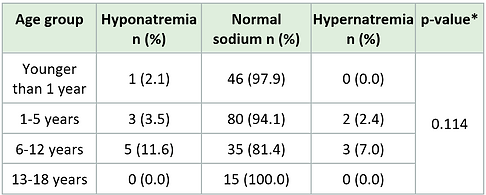
* Patients with normal electrolyte values are not shown.
TABLE 4 presents the distribution of potassium abnormalities across age groups. We observed a statistically significant association between age group and potassium abnormalities (Fisher-Freeman-Halton exact test, two-sided p=0.008). Hyperkalemia was observed predominantly among infants, whereas hypokalemia was most frequently observed among children aged 1–5 years.
TABLE 4. Distribution of potassium abnormalities according to age group among hospitalized pediatric patients with acute febrile diarrheal illnesses (N = 190)

* Pearson's chi-square test.
TABLE 5 presents the distribution of sodium abnormalities according to dehydration severity. Although sodium abnormalities were observed in both moderate and severe dehydration, dehydration severity was not significantly associated with sodium abnormalities (Fisher-Freeman-Halton exact test, two-sided p=0.417). The table also presents the distribution of potassium abnormalities by dehydration severity. Potassium abnormalities were observed in patients with both moderate and severe dehydration, with no statistically significant association between dehydration severity and potassium abnormalities (Fisher-Freeman-Halton exact test, two-sided p=1.000). No statistically conclusive association was detected; however, the small severe-dehydration subgroup and sparse abnormality counts limited the precision of these comparisons.
TABLE 5. Distribution of potassium and sodium abnormalities according to dehydration severity among hospitalized pediatric patients with acute febrile diarrheal illnesses (N = 190)
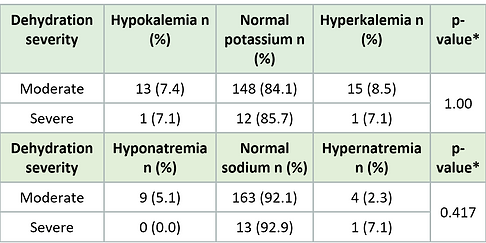
* Pearson's chi-square test.
DISCUSSION
In our study, potassium abnormalities were more common than sodium abnormalities in hospitalized children with acute febrile diarrheal illnesses, but this finding should be interpreted with caution. In children with acute diarrhea, hypokalemia is expected due to gastrointestinal losses of this electrolyte, and previous studies have consistently reported it as the predominant potassium disturbance. 6 Therefore, the relatively high frequency of hyperkalemia in our cohort was unexpected. Although we repeated elevated potassium results, we could not exclude pseudohyperkalemia because of hemolysis during blood collection, a well-recognized artifact in pediatric practice, particularly in infants, where obtaining blood samples can be technically challenging. 7
Although hyponatremia and hypokalemia were identified in our study, both occurred at relatively low frequencies. This differs from several previous studies that reported these abnormalities more commonly in children hospitalized with acute diarrheal illness. 4,5 Differences in patient populations, illness severity, and prehospital management may explain the discrepancy. Since most children in our cohort had moderate dehydration, this may have contributed to the lower prevalence of electrolyte disturbances observed.
Overall, electrolyte abnormalities varied only slightly across age groups. We observed a statistically significant association between age group and potassium abnormalities. Elevated potassium values occurred more frequently among infants; however, this pattern should be interpreted cautiously because pseudohyperkalemia could not be excluded. As this finding may reflect pseudohyperkalemia related to hemolysis during blood collection, it should be interpreted cautiously.
Another important finding was the lack of a significant association between electrolyte abnormalities and dehydration severity. Neither sodium nor potassium abnormalities were significantly associated with clinically assessed dehydration severity. Although electrolyte disturbances often become more pronounced as dehydration worsens and have been associated with dehydration severity in previous studies, 5 our findings suggest that dehydration severity alone may not reliably predict electrolyte imbalance in hospitalized children with acute febrile diarrheal illnesses. This may be because serum electrolyte concentrations are influenced by several factors, including diarrhea duration, the composition of gastrointestinal fluid losses, oral fluid intake, and any fluid replacement received before hospitalization. These findings highlight the importance of laboratory assessment, as clinical evaluation of dehydration alone may not accurately identify children with electrolyte abnormalities. The present study was not designed to determine whether routine or selective electrolyte testing is preferable for hospitalized children with acute febrile diarrheal illnesses. Prospective studies should evaluate which clinical criteria best identify children who would benefit from electrolyte testing and whether testing strategies improve clinical management, outcomes, and resource use.
Our study has several limitations to consider when interpreting the results. As A single-center retrospective cross-sectional study, the findings may not be generalizable to other populations. In addition, although all patients required hospitalization despite any prehospital measures, possible oral or intravenous fluid administration before arrival may have influenced admission electrolyte concentrations. Therefore, the results represent electrolyte values measured at hospital admission after the patient's prehospital course, rather than untreated electrolyte values. The dehydration categories were markedly imbalanced, with 176 patients classified as having moderate/some dehydration and only 14 as having severe dehydration. This imbalance limited the precision and statistical power of between-group comparisons. Accordingly, the absence of a statistically significant association should not be interpreted as evidence of no association. Despite these limitations, our study provides contemporary data on sodium and potassium abnormalities among hospitalized children with acute febrile diarrheal illnesses in Georgia, where published evidence remains scarce. This publication helps to address this important gap in the local literature. Further prospective, multicenter studies are needed to better define the prevalence and clinical significance of electrolyte abnormalities in this population.
CONCLUSIONS
We identified electrolyte abnormalities in a minority of hospitalized pediatric patients with acute febrile diarrheal illnesses. We found no statistically significant association between the recorded dehydration category and sodium or potassium abnormalities; however, the small number of patients with severe dehydration and the limited number of abnormalities limited the precision of this comparison. Interpret the observed potassium abnormalities, particularly among infants, cautiously because pseudohyperkalemia could not be excluded. Prospective studies are needed to determine which hospitalized children would benefit from electrolyte testing and whether routine or selective testing improves clinical management and outcomes.
AUTHOR AFFILIATION
1 Pediatric Infectious Diseases Department, Tbilisi State Medical University, Tbilisi, Georgia
2 Children’s Infectious Diseases Hospital, Tbilisi, Georgia
3 Ken Walker International University, Tbilisi, Georgia
REFERENCES
-
Tag ZM, Alashwal H, Chemaitelly H, Abu-Raddad LJ. Global childhood diarrhoea prevalence and its determinants: a systematic meta-analytic assessment, 1985-2024. EBioMedicine. 2025;121:105956. Published online October 14, 2025. doi:10.1016/j.ebiom.2025.105956
-
World Health Organization. The Treatment of Diarrhoea: A Manual for Physicians and Other Senior Health Workers. 4th ed. World Health Organization; 2005. Accessed January 2, 2026. WHO manual
-
Butler T, Islam M, Azad AK, Islam MR, Speelman P. Causes of death in diarrhoeal diseases after rehydration therapy: an autopsy study of 140 patients in Bangladesh. Bull World Health Organ. 1987;65(3):317-323.
-
Shah GS, Das BK, Kumar S, Singh MK, Bhandari GP. Acid base and electrolyte disturbance in diarrhoea. Kathmandu Univ Med J (KUMJ). 2007;5(1):60-62.
-
Syed AI, Tanvir A, Qamar I, Chaudhry AR. Analyzing the prevalence of serum electrolyte disturbance in children with acute diarrhea and dehydration. Pak J Med Health Sci. 2022;16(10):828-830. doi:10.53350/pjmhs221610828
-
Bamgbola OF. Review of the pathophysiologic and clinical aspects of hypokalemia in children and young adults: an update. Curr Treat Options Pediatr. 2022;8(3):96-114. Published online May 18, 2022. doi:10.1007/s40746-022-00240-3
-
Dietzen DJ, Jackups R, Zaydman MA. Clinical implications of inaccurate potassium determination in hemolyzed pediatric blood specimens. Clin Chim Acta. 2024;557:117862. doi:10.1016/j.cca.2024.117862