
GEORGIAN
BIOMEDICAL
& MEDICAL NEXUS
Former Georgian Biomedical News
ISSN (Online): 2720-8796
ORIGINAL RESEARCH
Health-Related Quality of Life in Georgian Children with Mendelian Disorders of the Epigenetic Machinery: A Cross-Sectional Study
Kakha Bregvadze1,ID, Luka Abashishvili1,ID, Helen Phagava2,ID, Elene Abzianidze1,ID, Tinatin Tkemaladze1,3,ID
ABSTRACT
Background: Mendelian disorders of the epigenetic machinery (MDEMs) represent a heterogeneous group of rare neurodevelopmental syndromes caused by pathogenic variants in genes encoding key components of the epigenetic apparatus. These conditions are commonly associated with intellectual disability, behavioral problems, multisystem comorbidities, and functional limitations, all of which are expected to affect health-related quality of life (HRQL) negatively.
Objectives: To evaluate HRQL in children with MDEMs in Georgia using the Patient-Reported Outcomes Measurement Information System (PROMIS).
Methods: In this cross-sectional study, 12 children aged 5–17 years with a diagnosis of MDEMs were enrolled. HRQL was assessed using PROMIS Parent Proxy Profile measures across five domains: anxiety, depressive symptoms, fatigue, pain interference, and physical functioning. Associations between HRQL domains and demographic and clinical variables were explored using correlation analyses.
Results: PROMIS assessments demonstrated reduced HRQL across all evaluated domains. The highest symptom burden was observed in fatigue (M=62.4) and pain interference (M=60.2), followed by anxiety (M=58.1) and depressive symptoms (M=54.0). Physical functioning was reduced (M= 38.3).
Conclusions: Children with MDEMs in Georgia exhibit markedly compromised HRQL. Routine assessment of HRQL may support more comprehensive clinical care. Further studies with larger cohorts are needed to better define HRQL patterns in individuals with MDEMs.
Keywords: Health-related quality of life (HRQL); Mendelian Disorders of the Epigenetic Machinery (MDEM); Patient-Reported Outcomes Measurement Information System (PROMIS).
DOI: 10.52340/GBMN.2025.01.01.145
INTRODUCTION
Mendelian disorders of the epigenetic machinery (MDEMs) comprise a group of neurodevelopmental conditions caused by pathogenic variants in genes encoding key components of the epigenetic machinery.1
These conditions involve disruption of the various components of the epigenetic apparatus, including writers, erasers, readers, and remodelers. They hence are expected to have widespread downstream epigenetic consequences.2 Although individually rare, MDEMs collectively constitute a common genetic etiology of developmental delay (DD), intellectual disability (ID), and multisystem morbidity.3 Clinically, MDEMs are characterized by a broad phenotypic spectrum that may include growth restriction, congenital anomalies, feeding difficulties, sleep disturbances, seizures, behavioral problems, and motor impairment.4 These manifestations often result in substantial limitations in daily functioning and long-term care needs. Health-related quality of life (HRQL) reflects an individual’s perceived physical, mental, and social well-being over time and represents an important outcome measure beyond traditional clinical endpoints. Several individual MDEMs, such as Cornelia de Lange and Rubinstein-Taybi syndromes, are associated with significantly reduced HRQL.5,6 In CHARGE syndrome, anxiety has been identified as a key factor influencing quality of life.7 However, data on HRQL across the broader spectrum of MDEMs remain limited. One instrument used to measure health-related quality of life (HRQL) is the Patient-Reported Outcomes Measurement Information System (PROMIS).8 PROMIS provides individual-focused tools to assess and monitor physical, mental, and social health in both adults and children. It was developed by the U.S. National Institutes of Health (NIH) as part of a significant, multicenter research initiative to advance the science of patient-reported outcome (PRO) measurement. The primary objective of PROMIS is to deliver reliable, precise, and standardized measures of self-reported health across a wide range of medical conditions and populations. PROMIS domains were identified through extensive qualitative research, literature reviews, and patient input to ensure strong content validity. PROMIS includes self-report measures for adults, self-report measures for children aged 8–17 years, and parent proxy-report measures for children aged 5–17 years. Currently, studies examining HRQL in children with MDEMs in Georgia are absent; therefore, our study aimed to evaluate HRQL in these children using the PROMIS tool
METHODS
The study cohort consisted of 12 children with MDEMs. Participants were enrolled through established physician referral networks and patient advocacy groups for rare disorders. Sociodemographic and clinical characteristics are presented in Table 1. HRQL was assessed using the PROMIS Parent Proxy Profile, which evaluates five domains: anxiety, depressive symptoms, fatigue, pain interference, and physical functioning. Raw PROMIS scores were transformed into standardized T-scores (mean = 50, SD = 10) in accordance with PROMIS scoring guidelines. Data were collected between January and July 2024. Associations between PROMIS domain scores and demographic and clinical variables (age, sex, and disease duration) were explored using correlation analyses. Due to the small sample size, analyses were considered exploratory. The TSMU Biomedical Research Ethics Committee approved the study. Written informed consent was obtained from parents or legal guardians before participation.
TABLE 1. Sociodemographic and Mendelian Disorders of the Epigenetic Machinery (MDEM) characteristics

Abbreviations: MDEM, Mendelian Disorders of the Epigenetic Machinery.
RESULTS
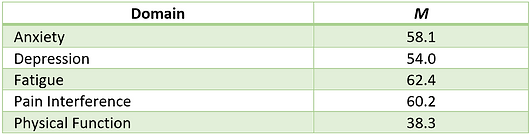
PROMIS mean scores were higher than reference norms for symptom domains and lower for physical functioning. The highest symptom burden was observed for fatigue (M = 62.4) and pain interference (M = 60.2), followed by anxiety (M = 58.1) and depressive symptoms (M = 54.0). Physical functioning scores were markedly below the normative mean (M = 38.3) (Tab.2)
TABLE 2. Characteristics of the study participants
Correlation analyses are summarized in Table 3. Age showed weak positive correlations with anxiety, depressive symptoms, fatigue, and pain interference, and a weak negative correlation with physical functioning. Sex showed minimal correlations across all domains. Disease duration showed weak positive correlations with symptom domains and a weak negative correlation with physical functioning. None of these associations reached statistical significance.
TABLE 3. Intercorrelations of sociodemographic and Mendelian Disorders of the Epigenetic Machinery (MDEM) characteristics

DISCUSSION
Our study presents the first assessment of health-related quality of life in Georgian children with MDEMs. Using PROMIS measures, we identified significant impairments across several domains, indicating that the impact of these conditions extends beyond core neurodevelopmental features. Fatigue and pain interference emerged as the most affected domains. Elevated fatigue may reflect the cumulative effects of motor impairment, sleep disturbances, seizures, and chronic medical comorbidities commonly reported in MDEMs.9-11 Increased pain interference may be related to musculoskeletal abnormalities, gastrointestinal issues, or limited mobility.11,12 Anxiety was also prominent and may be influenced by communication difficulties and reduced adaptive functioning.13,14 Correlation analyses showed weak trends toward higher symptom burden and lower physical function with increasing age and longer disease duration. The associations were not statistically significant, likely due to the small sample size; however, they may suggest a cumulative effect of disease over time. Several limitations warrant consideration. The small and diagnostically heterogeneous sample limits generalizability and restricts robust statistical inference. Furthermore, the cross-sectional study design does not permit evaluation of longitudinal changes in HRQL.
CONCLUSIONS
Children with MDEMs in Georgia exhibit reduced HRQL across multiple domains, including anxiety, depressive symptoms, fatigue, pain interference, and physical functioning. Our findings highlight the need for systematic HRQL assessment in individuals with MDEMs and provide a foundation for future large-scale studies.
AUTHOR AFFILIATION
1 Department of Molecular and Medical Genetics, Tbilisi State Medical University, Tbilisi, Georgia;
2 Department of Epidemiology and Biostatistics, Tbilisi State Medical University, Tbilisi, Georgia;
3 Division of Clinical Genetics, Givi Zhvania Pediatric University Clinic, Tbilisi State Medical University, Tbilisi, Georgia.
REFERENCES
-
Fahrner JA, Bjornsson HT. Mendelian disorders of the epigenetic machinery: postnatal malleability and therapeutic prospects. Hum Mol Genet. 2019;28(R2):R254-R264. doi:10.1093/hmg/ddz174
-
Fahrner JA, Bjornsson HT. Mendelian disorders of the epigenetic machinery: tipping the balance of chromatin states. Annu Rev Genomics Hum Genet. 2014;15:269-293. doi:10.1146/annurev-genom-090613-094245
-
Bjornsson HT. The Mendelian disorders of the epigenetic machinery. Genome Res. 2015;25(10):1473-1481. doi:10.1101/gr.190629.115
-
Donoghue S, Wright J, Voss AK, Lockhart PJ, Amor DJ. The Mendelian disorders of chromatin machinery: Harnessing metabolic pathways and therapies for treatment. Mol Genet Metab. 2024;142(1):108360. doi:10.1016/j.ymgme.2024.108360
-
Trujillano L, Ayerza-Casas A, Puisac B, et al. Assessment of Quality of Life Using the Kidslife Scale in Individuals With Cornelia de Lange Syndrome. Cureus. 2024;16(4):e57378. doi:10.7759/cureus.57378
-
Vale AR, de Avó LRDS, Pilotto RF, Germano CMR, Melo DG. Quality of life of Brazilian families who have children with Rubinstein-Taybi syndrome: An exploratory cross-sectional study. Am J Med Genet A. 2022;188(11):3294-3305. doi:10.1002/ajmg.a.62914
-
Hartshorne N, Hudson A, MacCuspie J, et al. Quality of life in adolescents and adults with CHARGE syndrome. Am J Med Genet A. 2016;170(8):2012-2021. doi:10.1002/ajmg.a.37769
-
HealthMeasures. Introduction to PROMIS. HealthMeasures. https://www.healthmeasures.net/explore-measurement-systems/promis/intro-to-promis. Accessed December 12, 2025.
-
Rozensztrauch A, Basiak A, Twardak I. Rubinstein-Taybi Syndrome Clinical Characteristics from the Perspective of Quality of Life and the Impact of the Disease on Family Functioning. J Clin Med. 2024;13(17):5210. Published 2024 Sep 2. doi:10.3390/jcm13175210
-
Parisi L, Di Filippo T, Roccella M. The Quality of Life in Girls with Rett Syndrome. Ment Illn. 2016;8(1):6302. Published 2016 May 18. doi:10.4081/mi.2016.6302
-
Lacombe D, Bloch-Zupan A, Bredrup C, et al. Diagnosis and management in Rubinstein-Taybi syndrome: first international consensus statement. J Med Genet. 2024;61(6):503-519. Published 2024 May 21. doi:10.1136/jmg-2023-109438
-
Bullinger M, Schmidt S, Petersen C; DISABKIDS Group. Assessing quality of life of children with chronic health conditions and disabilities: a European approach. Int J Rehabil Res. 2002;25(3):197-206. doi:10.1097/00004356-200209000-00005
-
Kalinousky AJ, Rapp T, Hijazi H, Johnson J, Bjornsson HT, Harris JR. Neurobehavioral phenotype of Kabuki syndrome: Anxiety is a common feature. Front Genet. 2022;13:1007046. Published 2022 Oct 6. doi:10.3389/fgene.2022.1007046
-
Ng R, Harris J, Kleefstra T, Morgan AT, Simpson B. Editorial: Characterizing the neurobehavioral phenotype of mendelian disorders of epigenetic machinery. Front Genet. 2023;14:1338078. Published 2023 Dec 5. doi:10.3389/fgene.2023.1338078